What Helps?
Twelve sets of everyday situations. Something happens, someone does something, and your child works out what that does.
- Ages 5–9
- Autistic and ADHD children
- Early readers
- Free, no sign-up
Pick a skill. Your child sees a small everyday moment, decides what somebody's action does next, and finds out why.
Five situations a go. About three minutes.
Talking with people
Keeping a conversation going, joining one, taking turns, and getting heard.
Keeping a conversation going
Somebody says something, and what comes back either gives them somewhere to go or leaves them nowhere. Your child works out which.
18 situations · 5–9
Joining a conversation
Two people are already talking. Your child works out which ways in leave room for them and which ones shut the door.
18 situations · 5–9
Taking turns talking
Conversations run on turns. Your child works out which actions hand the other person a turn and which ones take it.
18 situations · 5–9
Getting someone's attention
You have something to say and nobody has heard it yet. Your child works out which ways of getting heard actually arrive.
18 situations · 5–9
Playing with others
Games that keep going, sharing and turns, and asking before touching or borrowing.
Winning and losing games
Board games, races, the last round of tiggy. This is about what happens to the game after somebody wins, not about minding less.
18 situations · 5–9
Sharing and turns
One tub of blocks, two children, and a limited number of the red ones. This is about turns that work, not about handing everything over.
18 situations · 5–9
Space and asking first
Hugs, tickles, borrowing a rubber, standing very close. This is about asking before, and about what happens when somebody says no.
18 situations · 5–9
Solving everyday problems
Asking for help, and what to do when something goes wrong.
Asking for help
Something is stuck, and help exists somewhere in the room. Your child works out which moves reach it and which leave them stuck.
18 situations · 5–9
When something goes wrong
A spill, a broken piece, a knocked-over tower. Your child works out which next moves sort it out and which keep it going.
18 situations · 5–9
When things change
Plans that change, and waiting for something.
When plans change
The trip is off, the shop is shut, the teacher swaps the plan. This is about what a child does in the ten minutes after.
18 situations · 5–9
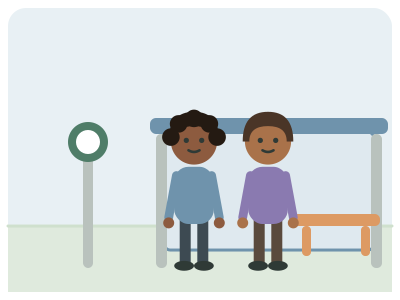
Waiting
Queues, turns, and the ten minutes before something begins. This is about what a child does with that time, not about how still they are.
18 situations · 5–9
Feelings and actions
Every feeling is okay. This is about what happens next.
Something else happened today?
Type what happened in your own words and get a short story you can go through together.
Try the Situation CoachHow it works
- Pick a skill. Your child sees a small everyday moment — two children talking, a game, a queue — and what somebody does next.
- They decide which of two things that action does. Every pack has its own two, in its own words: keeps it going or makes it stop, gets you help or leaves you stuck.
- Whichever they choose, the next screen says what that action does and why, and gives them one concrete thing to try instead.
- Five situations is a session, about three minutes. Some situations show a short demonstration of what happens next.
Who this is for
Children of about five to nine who understand a concrete example far better than an explanation, and who need the same idea shown in a dozen different afternoons before it sticks. It is written for autistic and ADHD children in particular, which mostly means what it refuses to teach rather than what it teaches.
If something has just happened at home and it is not one of these twelve, the Situation Coach takes it in your own words instead.
What it will not do
- It does not keep a score. There is no mark, no percentage, no streak and no “4 out of 5” — the explanation is the point, not the tap.
- It does not teach eye contact, and it never treats looking away, fidgeting, moving or going quiet as the reason something did not work.
- It does not teach that a child must share everything, accept a hug, keep talking when they have had enough, or do what another child says.
- It does not give absolute rules. Interrupting is the right thing to do when somebody is hurt, and the packs say so.
What this sends anywhere
Nothing about your child. The 12 packs and 216 situations are written into the site and served as ordinary pages; there is no account, no sign-up and no model call. Which situations have come up recently is kept in this browser so the next session is not the last one again, and it is a list of card names — never anything about how they were answered.
More from Roo Bloom
 Situation Pack
Haircut Pack
What happens at a haircut, how it might feel, and what your child can do about it — personalised with their name and character.
Open the pack → Situation Pack
Dentist Visit Pack
What happens at a dental check-up, how it might feel, and what your child can do about it — personalised with their name and character.
Open the pack →
Screen-Time Transition Pack
A visual transition story with countdown cards, a step-by-step sequence and a first–then board for finishing screen time calmly.
View and download →
Print the sorting cards
Every pack has a printable version: two category mats and a page of cut-out cards, with a discreet answer key for the adult on the last sheet. A4, and nothing is printed on the back of the cards page so the scissors cannot destroy anything.
See a packSocial situations depend on the people in them. Everything here is one common way things tend to go, not a rule. This is an educational resource, not therapy or medical advice.