Practice Being Flexible
Practise handling mistakes, accidents and unexpected changes — one small step at a time.
- Autistic children
- Children with ADHD
- Children who find mistakes hard
- Children who find changes of plan hard
What happened?
Choose something that's been tricky lately.
We'll look at what might help, then try a few together.
New to this? first — it takes a minute.
For grown-ups: what this teaches
The idea
Different Oops moments need different tools. The whole resource turns on one question — and it is the question, not any one answer, that transfers off the screen.
Ask
“Can we change it now?”
- Yes, now
 Fix itThis one can be changed.
 - Not now
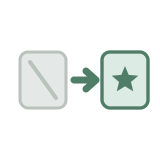 Next timeNot this time. It can be different next time.
 - It already happened
 Handle what's nextThat part can't be undone. What happens next still can be.
 - It's stuck
 Restart may helpThis one has stopped working. Starting again may help.
“It's stuck” is the situation. Restart is the tool. A stuck activity usually wants restarting — but it might just as well want a grown-up to look at it, and plenty of things that are not stuck get restarted out of habit. So Restart is a tool, not a mistake: right for a frozen game, wrong for a puzzle piece in the wrong hole.
 Try againOne small step, over again.RestartThe whole activity, from the beginning.
Why the spill stays on the screen
In a few scenarios the unwanted thing is pinned in view while your child carries on around it — the car stays red, the spill stays spilled, the mark stays on the picture. Answering “not until next game” is a fact a child can hold; finishing the race in the red car is the skill.
The shared language · The Oops Plan
- 1
 OopsThat wasn't what I expected.
 - 2
 PauseI can stop for a moment.
 - 3
 Be FlexibleI can handle a little change.
 - 4
 ChooseWhat can I do?
 - 5
 Keep GoingI can carry on.
At home
“It's an Oops moment. What can we do?” and then “What does this Oops need?”
Good to know
There is no score, no timer and nothing saved. Stopping part-way through costs nothing, and Stop practice is on every screen. Start with situations your child can handle comfortably — the goal is successful recovery, not creating distress.
97 practice situations, drawn on at random so a session is different each time. The boy and girl versions contain exactly the same words; only the child in the pictures changes.
Being flexible is for small, safe disappointments — a different cup, a busy swing, a slipped click. It never means putting up with pain, fear, hunger, bullying or anything that feels unsafe. In those, telling an adult is the right answer, and nothing here suggests otherwise.
This is an educational resource, not therapy or medical advice.